








The puzzle is finished, it has been sitting on the table for three days, and somebody wants the table back. What happens next decides whether it goes back in the box or onto a wall, and the wall route depends far more on the board underneath than on the glue itself.
This guide assumes you are gluing. It covers which glue seals a wooden puzzle, which board to mount it on, how to fix a shape with no straight edges to it, how long to wait, and how to hang the result on a wall without it coming down.
Why a board, and when to leave the puzzle loose
Most advice about mounting puzzles is written for cardboard, where the board does an obvious job: a metre of glued card has no rigidity of its own and will sag off a wall within a season. A wooden puzzle arrives at that question differently, because each piece is already a tile of sheet wood about 4 mm thick and holds its own shape.
What the board does for a wooden puzzle is three narrower things. It holds every piece in the same plane, so that one tile sitting a millimetre proud of its neighbours cannot be knocked further. It gives you a continuous surface to fix hanging hardware to, which the puzzle itself does not have. And it protects the outline, which on a silhouette design is a run of thin necks and points that are the first things to catch on a doorframe.
Before any of that, the honest question. Gluing is permanent. A sealed puzzle cannot be taken apart and rebuilt, and some people assemble the same puzzle several times before deciding what it is for. If the puzzle is going on a wall, glue it. If it is going back in its box, leave it alone and skip the rest of this page.
Which glue is best for a wooden puzzle?
The product to look for is a water-based glue-varnish sold for puzzles. It does two jobs in one pass: the liquid runs down into the joints between the pieces and holds them there, and what stays on the surface dries as a transparent film. There is no separate sealing step and no second product.
Ours is Cléo'Puzzle, made in France, which the maker rates for cardboard, wood and MDF. The method printed by the maker is to lay the puzzle on its support first, then work the glue into the joints from the decorated face, and if the puzzle has not taken to the support that way, to bond the reverse as well.
Two details separate the formats. A wide pot suits a brush and a rectangular cardboard jigsaw, where you can flood the surface and drag the excess off the edge with a card. A bottle with a fine nozzle suits an outline that has no edge to drag anything off, because you can lay glue along one joint at a time and stop before it runs over the silhouette. On our animal designs that control is the difference between a sealed puzzle and a bead of dried gloss along the ears.
One thing worth knowing before you buy any bottle: not every puzzle glue is sold for bonding the finished puzzle to a support. Some makers rate theirs for the joints only and point you to a general-purpose adhesive for the board. Sealing the face and fixing the puzzle down are two jobs, so read the back of yours before assuming one product covers the pair.

The glue we sell
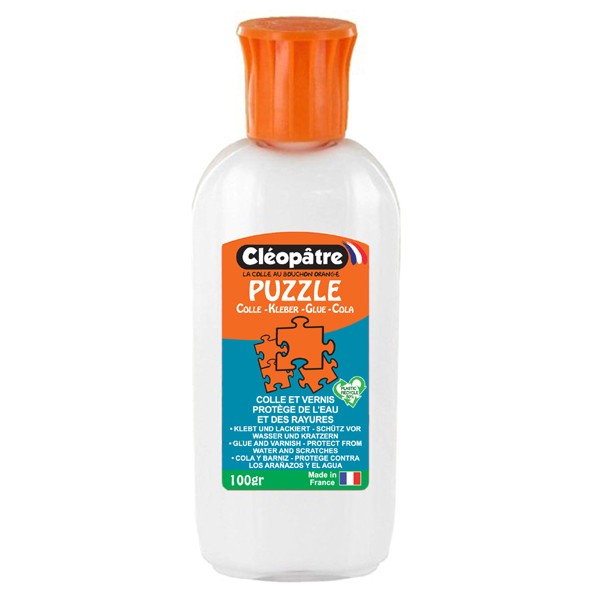
Cléo'Puzzle glue varnish, 100 g
Rated by its maker for cardboard, wood and MDF – it fixes the pieces and leaves a clear protective coat in one pass, and the fine nozzle drops it joint by joint.
See the glueOn which board do you glue a puzzle?
Four materials come up, and they are not interchangeable once a wooden puzzle is involved.
Plywood
A sheet of thin birch plywood matches the puzzle for stiffness and stays flat under its own weight at these sizes. It also takes glue on a bare, sanded face, which coated boards do not do as readily. It is the heaviest of the four and the hardest to cut at home, and at 4 mm it is too thin to hold a screw, which matters when you get to hanging.
MDF
Cuts cleanly, sits flat, and is sold in thicknesses that will hold a screw. It is heavier than plywood for the same panel and its cut edges drink up liquid, so an unsealed edge on a board larger than the puzzle will look different from the faces.
Foam board
The standard recommendation in every cardboard-puzzle guide, and the reason is real: it is light, it cuts with a craft knife against a straight edge, and a cardboard puzzle weighs almost nothing. A wooden puzzle is a different proposition. It weighs several times more for the same area, and foam core will not hold a screw or a sawtooth hanger at all, so everything then depends on an adhesive fixing to the wall.
Mat board and thick card
Sold with frames and useful inside one, where the frame carries the weight and the board only has to keep the puzzle flat. On its own on a wall, it is doing structural work it was not made for.
What if the puzzle has no straight edges?
Every guide tells you to lay the puzzle on the board, draw round it, and cut along the pencil line with a straight edge and a blade. That instruction assumes a rectangle. Our puzzles are silhouettes, so there is no straight edge to cut to and no outline a craft knife can follow without leaving facets across every curve.
There are two honest answers. Either the board becomes a deliberate shape of its own, a rectangle or a rounded panel cut larger than the puzzle so that it reads as a mount and the silhouette sits on it. Or the board is cut smaller than the puzzle at every point, so that it disappears behind the piece and the outline still reads as a free shape against the wall. The second takes longer and needs a jigsaw or a coping saw rather than a knife, and it is the one that keeps the design intact.
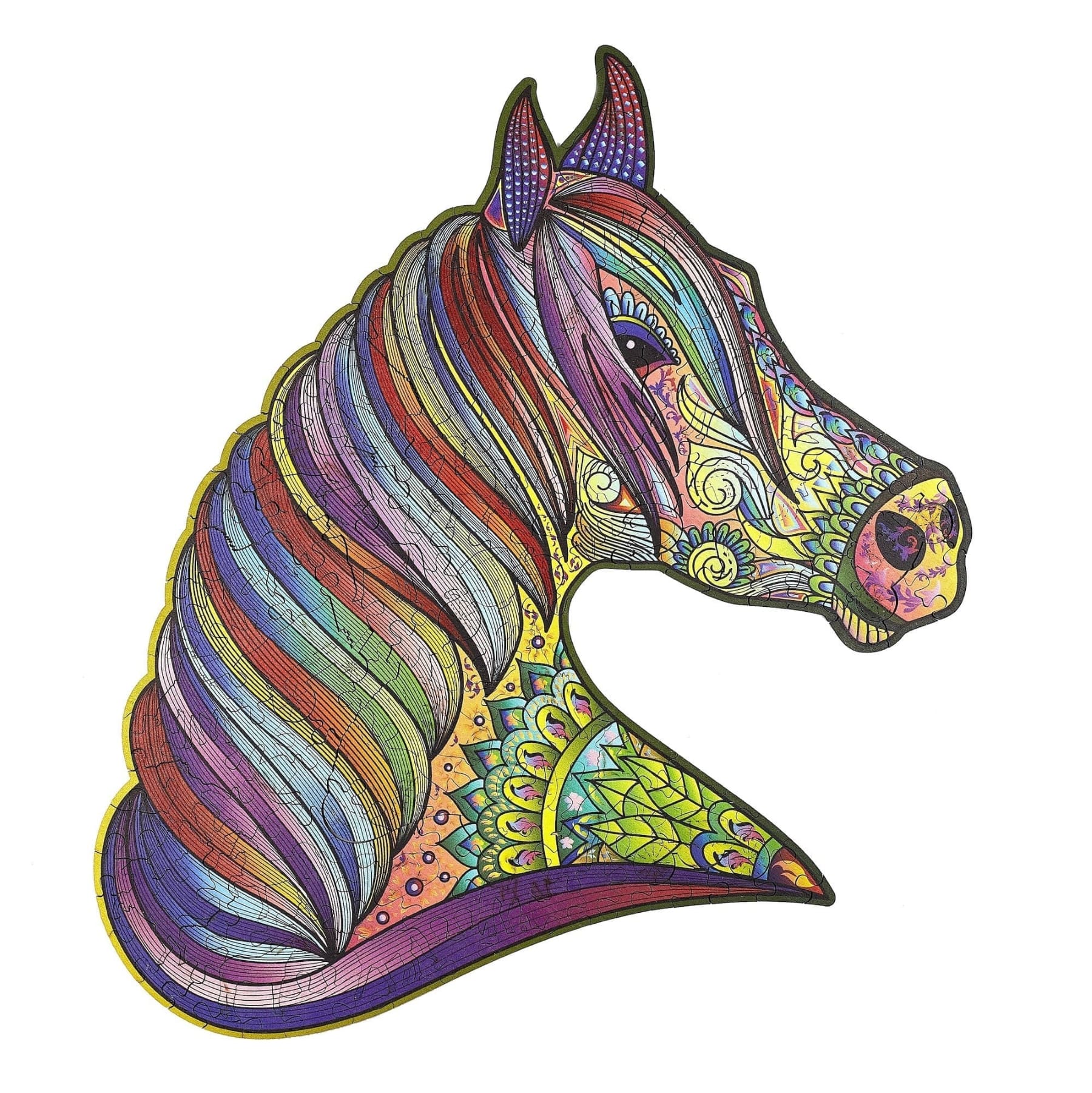
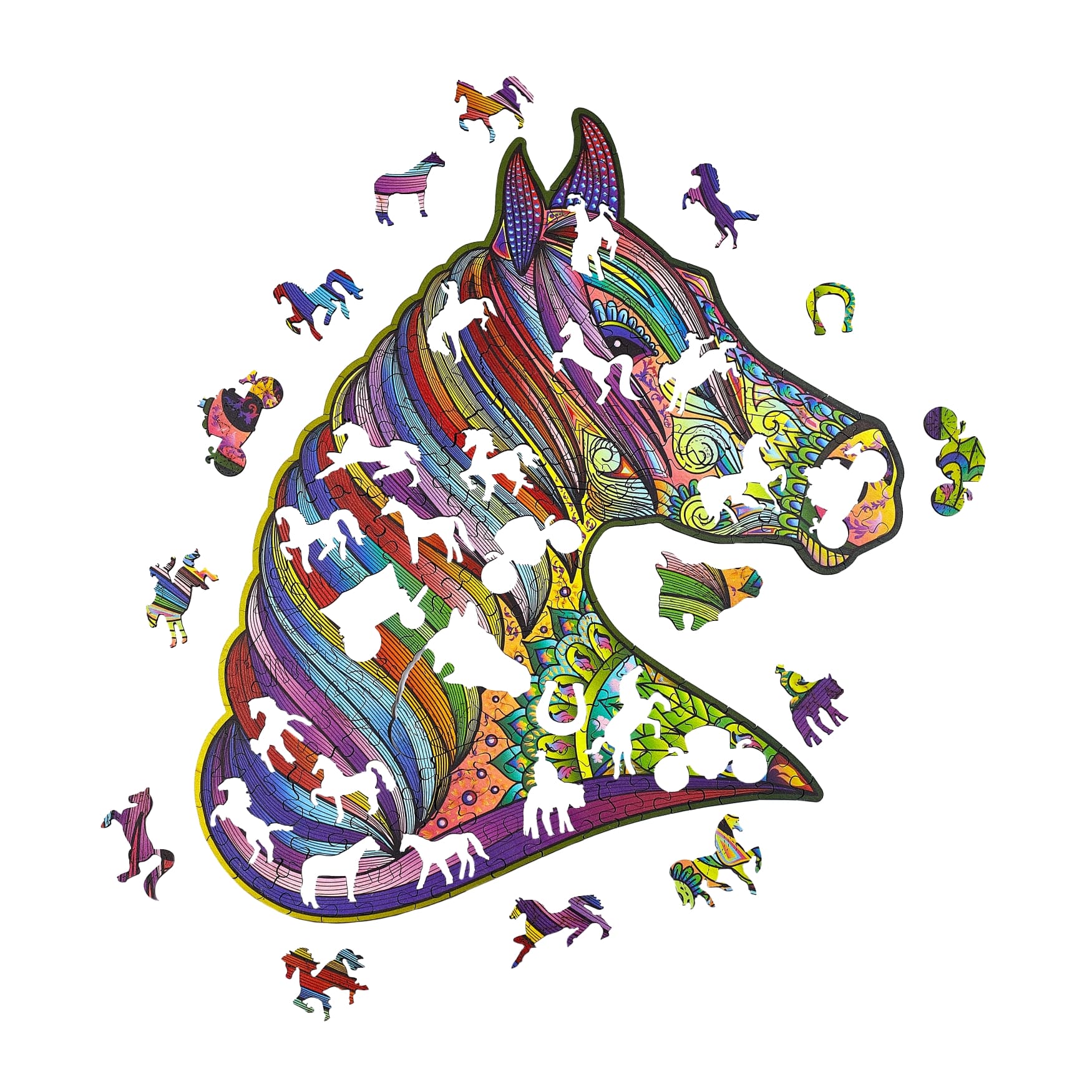
For the extreme case, look at the Fiery Horse below: a mane of loose points and not one straight edge anywhere. And whatever the old stories say about horses and glue, this is the only horse in the job.

A puzzle with no straight edge
The Fiery Horse Wooden Puzzle
Every point of that mane wants its own outline – the puzzle the board-cutting advice above was written for.
See the puzzle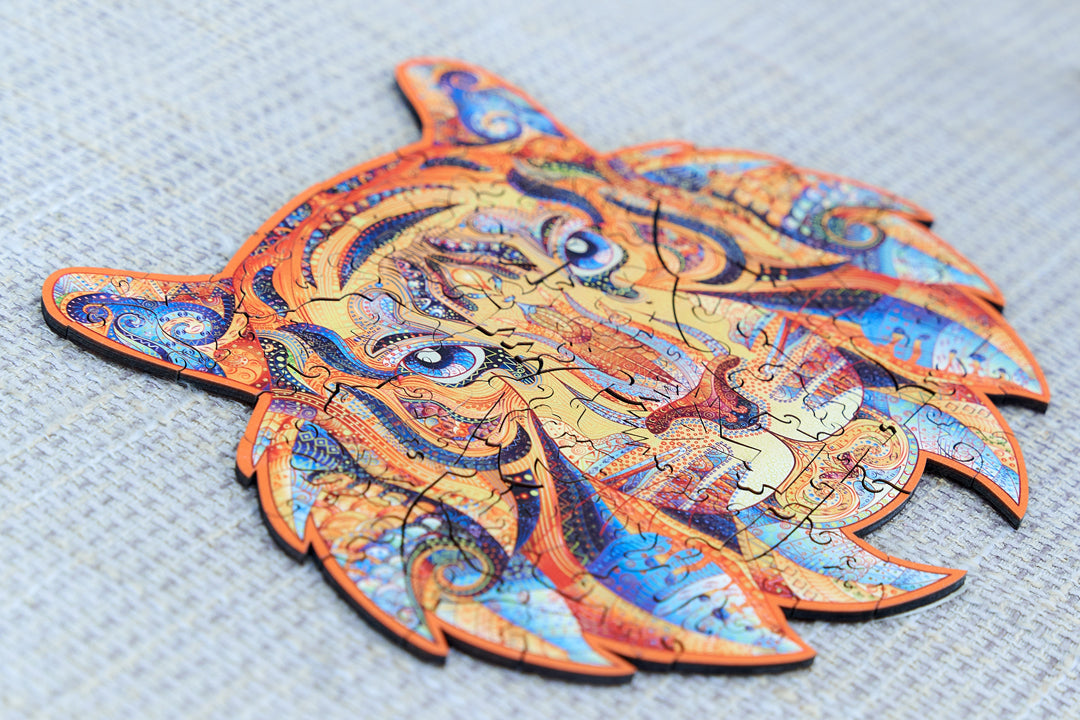
How do you glue a puzzle onto a plywood board?
Work on a hard, flat surface. A puzzle assembled on a blanket or a rug, which is where most of them get assembled, sits on a surface that gives under pressure, and pressing a board onto it there will push individual pieces out of plane. Slide a rigid sheet under the whole puzzle first and move it to a table.
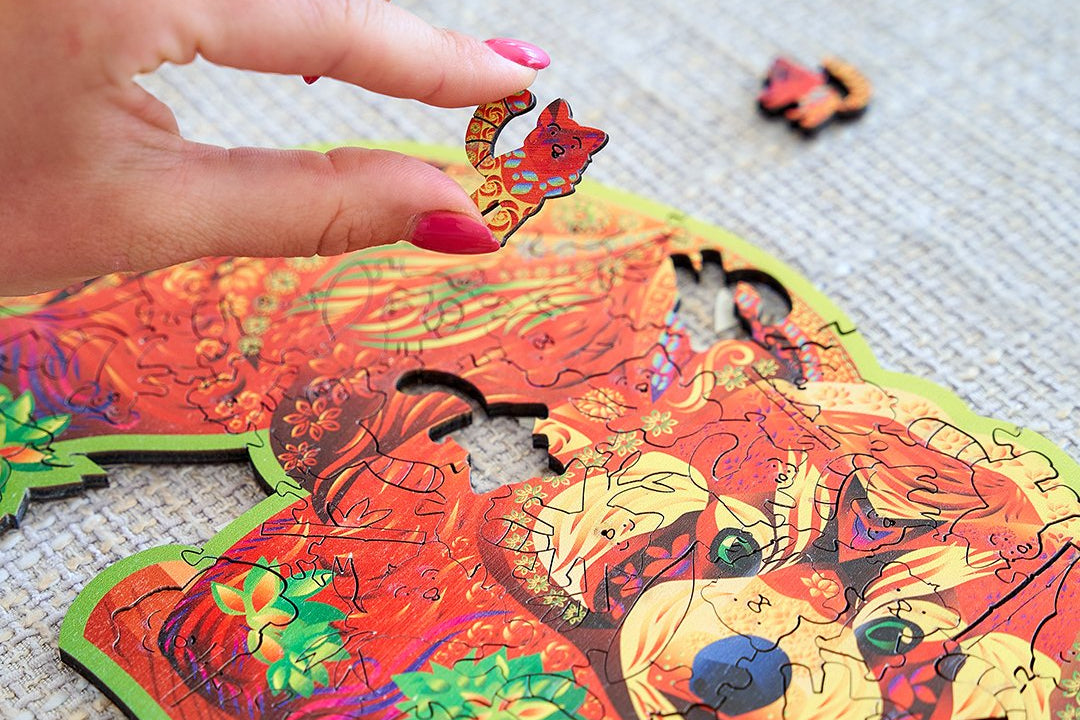
Seal the face first and let it dry. A puzzle that is already bonded into one sheet can be handled, lifted at the edges and positioned on the board without a piece dropping out of the middle, and that is what makes the second stage possible on your own.
Then bond it down. Spread adhesive across the board rather than onto the back of the puzzle, since the board is the surface you can see and reach, and lower the puzzle onto it from the middle outwards so that no air is trapped under the centre.
Pressure is where the standard advice fails. Wood adhesives expect clamping, and clamps need parallel edges to grip. A silhouette has none. What works instead is a caul: a flat, rigid sheet larger than the puzzle laid over the whole face, with weight spread across it. Books stacked directly on the puzzle put all the load on whichever pieces stand proudest, and the outline pieces, the ones with the least surface holding them down, are exactly where the failures show up two months later.
How long does the glue take to dry?
Longer than the surface suggests. The maker of the glue we sell prints no drying time on the bottle, and figures published for other puzzle glue-varnishes run to about an hour to the touch and a full day before the puzzle is treated as finished. General wood adhesives publish full strength at 24 hours at room temperature. Cold rooms and damp rooms extend all of these.
Two thin coats dry faster and hold better than one thick one. Whatever the bottle says about handling, wait a day before you hang anything.
How do you hang a wooden puzzle on the wall?
Start with what it weighs, because that decides everything else. A silhouette the size of a sheet of paper is a few hundred grams of wood; even our largest board, 42 by 39 cm, is well under a kilogram once it is on a plywood mount. That is lighter than most framed pictures, and it opens up options a framed picture does not have.
It also sets a trap. Adhesive picture-hanging strips are rated for painted walls and for finished wood, meaning sealed or painted surfaces, and their makers publish no rating for bare wood. A plywood board straight off the saw is bare wood. Either seal or paint the back of the board where the strip will sit, or use a fixing that does not rely on adhesion to the board at all.
The mechanical options need thickness. A sawtooth hanger or a D-ring is fixed with short screws, and 4 mm of plywood will not hold them, so if you want screwed hardware, build the board from 6 to 9 mm stock rather than matching the puzzle. A keyhole slot routed into a thicker board is the tidiest result of all, because nothing protrudes and the piece sits flat against the wall.
Can you mount a wooden puzzle without gluing it?
Not everybody wants the decision to be permanent, and there are three reversible routes, each with a real limit.
Adhesive backing sheets are sold for exactly this and go on the reverse of the assembled puzzle. They are made for cardboard puzzles, where the back of the finished puzzle is one continuous plane of card, so a sheet touches every piece at once.
Double-sided mounting squares are rated for loads far above what a puzzle weighs, on smooth and firm surfaces. The catch is not the rating but the geometry: a square only holds the piece it is stuck to. Cardboard pieces are all joined to a paper backing, so a handful of squares can hold a whole puzzle. Ours are separate wooden tiles with nothing connecting them but the glue in the joints, so a square under one tile does nothing for its neighbour. Either the face is sealed first, in which case the squares are holding a single rigid object, or you need something under nearly every piece.
The route with no adhesive at all is a shallow tray: a board with a lip, or a floating shelf deep enough to hold the puzzle at a slight angle. The puzzle stays loose, it can be lifted out and rebuilt, and nothing about it is permanent. It also cannot be hung flat, which is usually the point.
Hang it, or frame it?
A board and a fixing is the shorter route and it keeps the outline visible against the wall, which is what most silhouette designs are drawn for. A frame protects the surface from dust and knocks, and it solves the hanging problem outright, at the cost of putting a rectangle around a shape that was cut to avoid one. Framing a puzzle with no straight edges has its own complications, and those get a guide of their own.
If a piece has gone missing somewhere between the table and the board, our missing pieces page covers what we can do about it. The rest of the range is on the wooden puzzles page.
Questions we get asked
Can you use wood glue on a wooden puzzle?
For bonding a sealed puzzle to a board, yes. For sealing the face, no. Standard white wood glue goes on opaque and is made for a pressed joint between two surfaces, not for a visible film across a decorated face. It also expects clamping pressure held for a stated time, which a puzzle with no straight edges cannot easily be given.
How long does puzzle glue take to dry?
Published figures for puzzle glue-varnishes run to about an hour to the touch, with a full day before the puzzle is handled as a finished object. General wood adhesives publish full strength at 24 hours at room temperature. Cold or damp conditions extend both. If your bottle prints a figure, that one wins.
Foam board or plywood for a wooden puzzle?
Plywood, in most cases. Foam board is the standard answer for cardboard puzzles because it is light and cuts with a knife, but it will not hold a screw or a sawtooth hanger, so a foam-mounted puzzle can only ever be hung with an adhesive fixing. A wooden puzzle is heavy enough, relative to the board, that this becomes the weak point.
Can you hang a wooden puzzle without a frame?
Yes, and it is the usual way to do it. The puzzle is sealed, bonded to a board cut to shape, and hung from hardware fixed to that board. No frame is involved at any stage, and the silhouette stays visible against the wall rather than sitting inside a rectangle.
Can a glued puzzle be taken apart again?
No. A glue-varnish sets in the joints between the pieces, and the bond cannot be reversed without damaging the decorated faces. This is the reason to be certain before starting, particularly with a design somebody expects to assemble more than once.

Laisser un commentaire
Tous les commentaires sont modérés avant d'être publiés.
Ce site est protégé par hCaptcha, et la Politique de confidentialité et les Conditions de service de hCaptcha s’appliquent.