






Wine Maps
Filters
5 products


Continue exploring

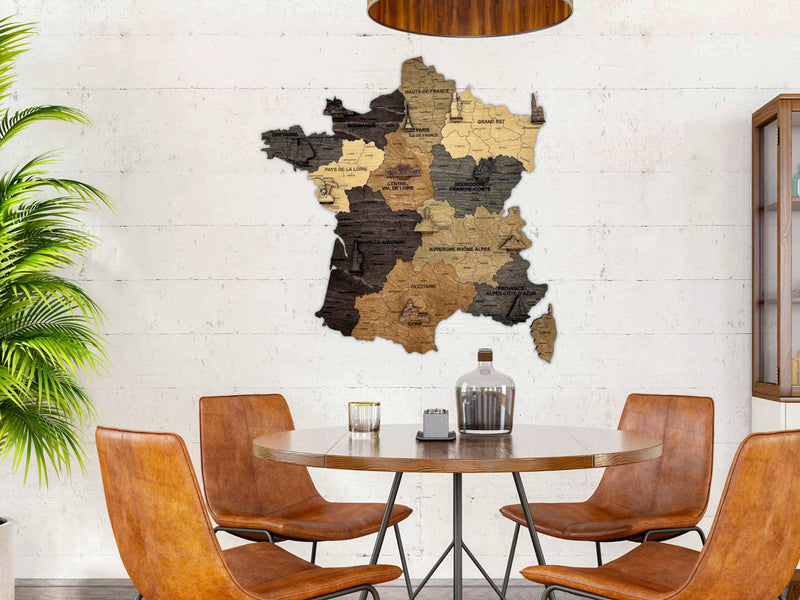

Wine regions, cut in wood
Each of these maps shows a wine-producing country divided the way a wine label divides it: by region and by vineyard rather than by administrative border. Bordeaux, Burgundy, the Loire, the Rhône; Piedmont, Tuscany, Sicily. The country is a base sheet of wood with the départements and towns engraved, and the vineyards are separate pieces raised on top of it, each in its own tone.
They are read differently from a world map. Nobody points at a wine map to find a place; they point at it to remember a bottle.
Which format for which wall?
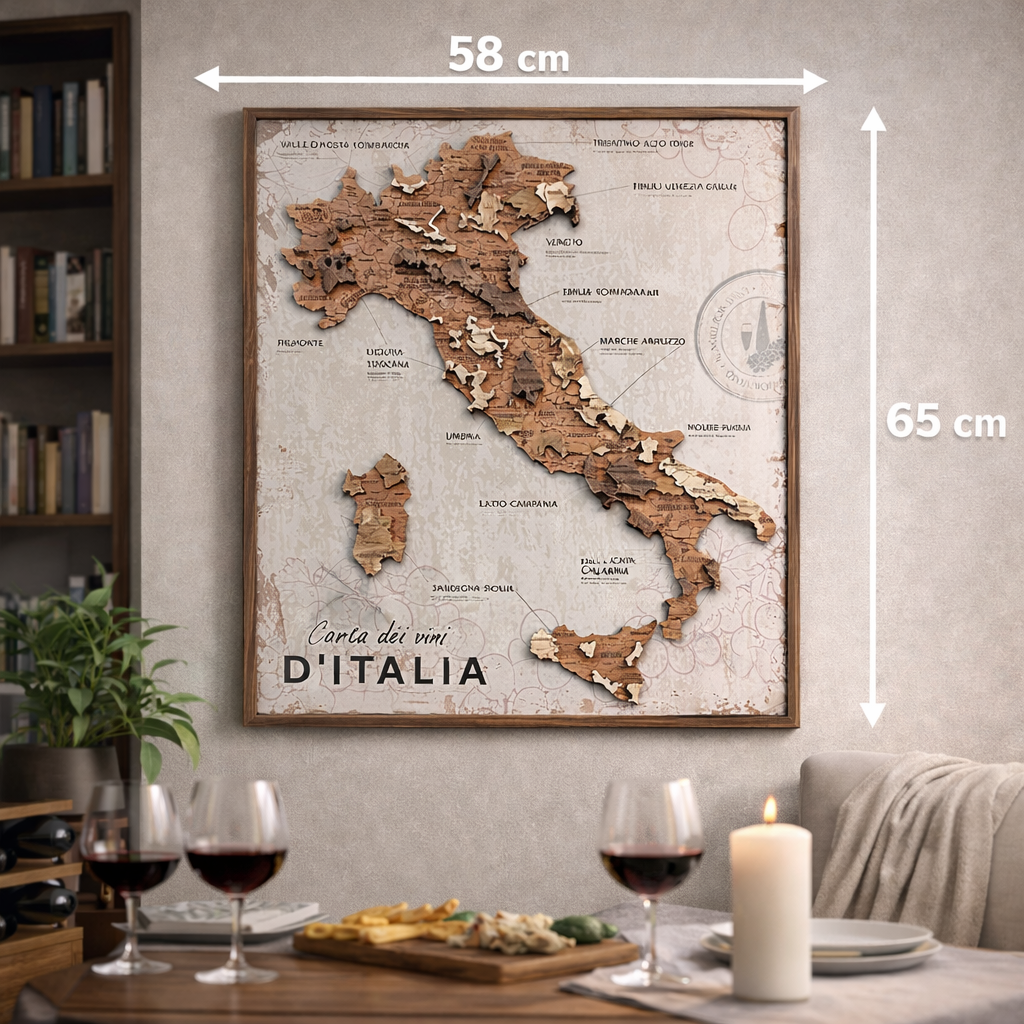
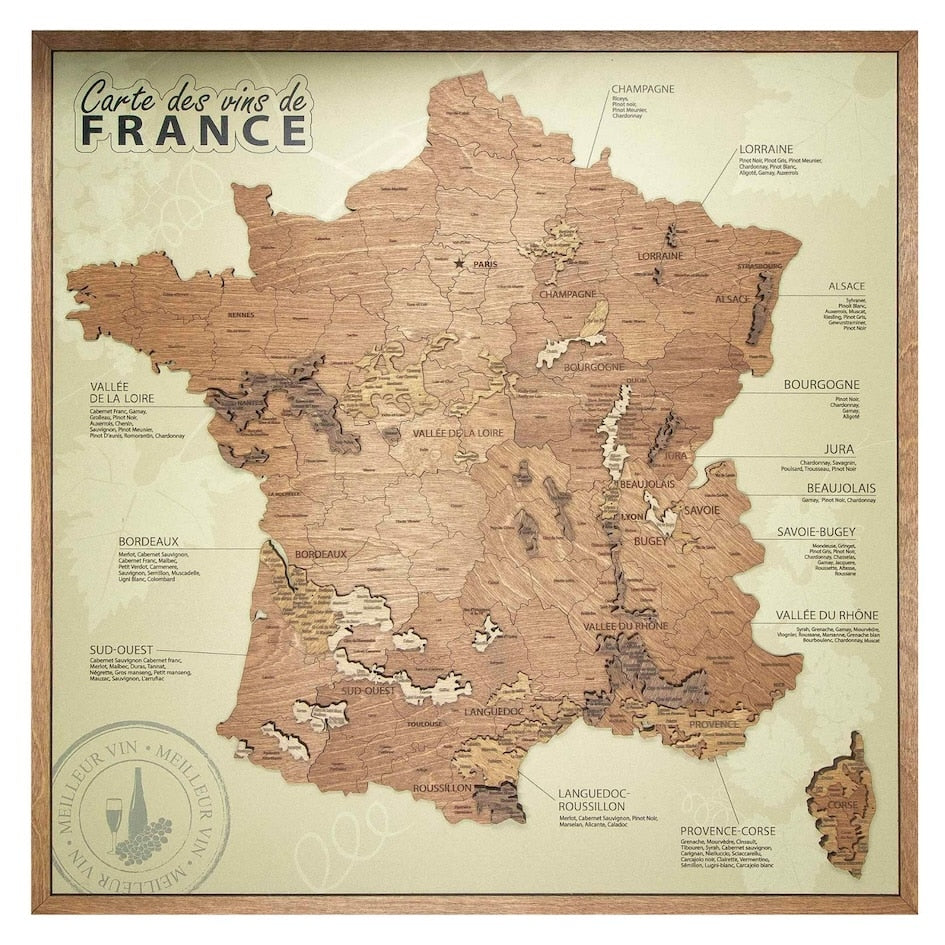
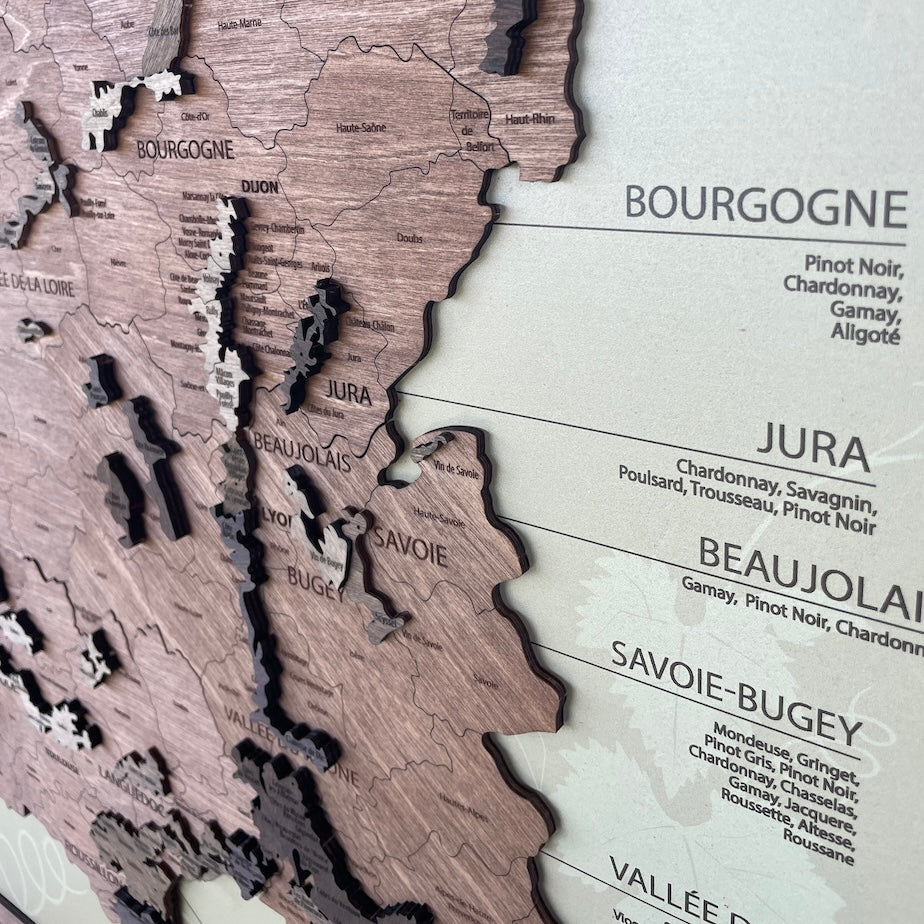
The panels arrive assembled and framed. The wooden country sits on a printed chart that carries the region names with their grape varieties, a title cartouche and a wine seal, and the whole thing hangs from the fixing built into the back. It reads as a framed picture and sits comfortably in a room of framed pictures.
The wooden maps have no chart behind them. The country and its badges are mounted directly on the wall, so the wall itself becomes the paper. They take an hour or two to build and put up, and they want clear space around them.
Which grape varieties are on the badges?
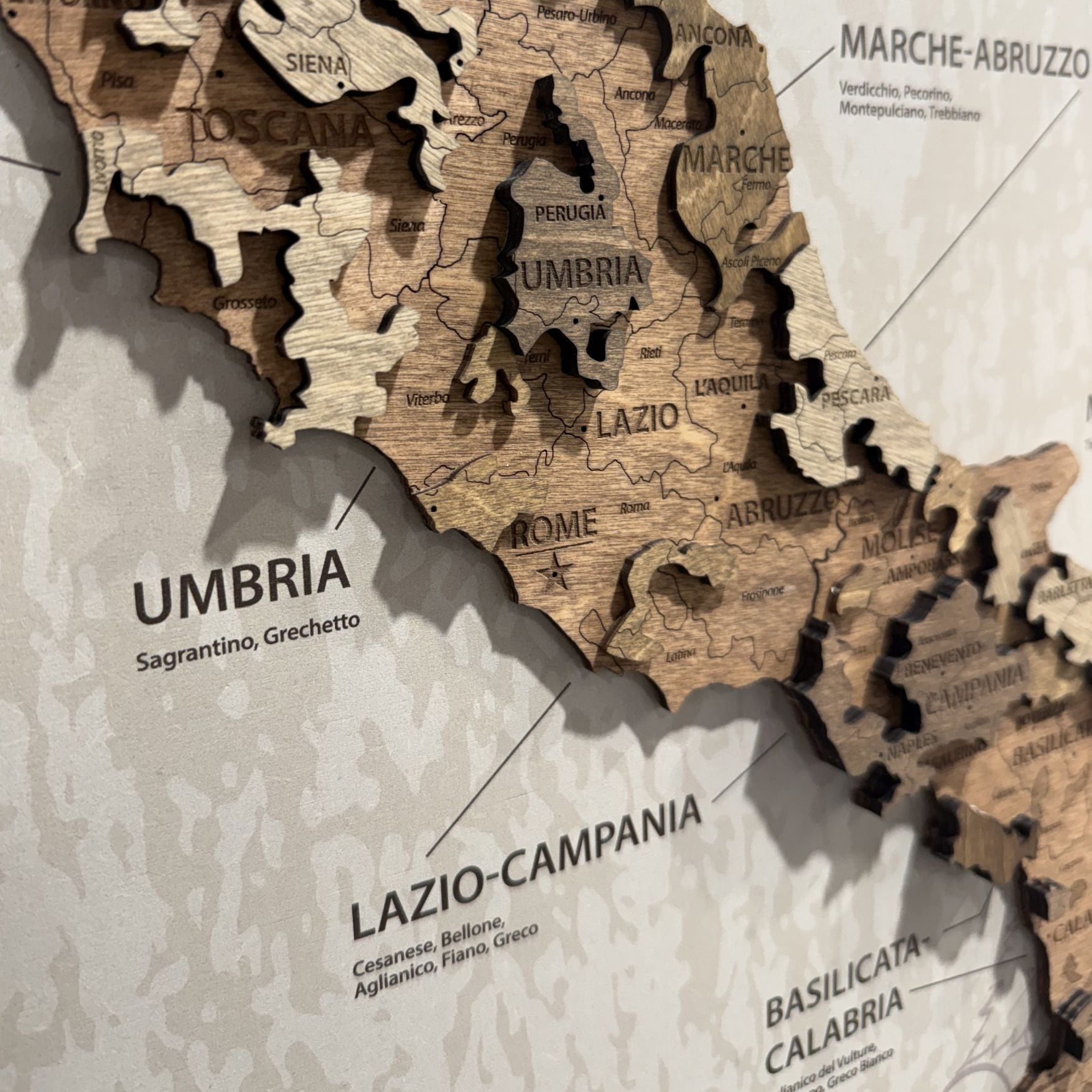
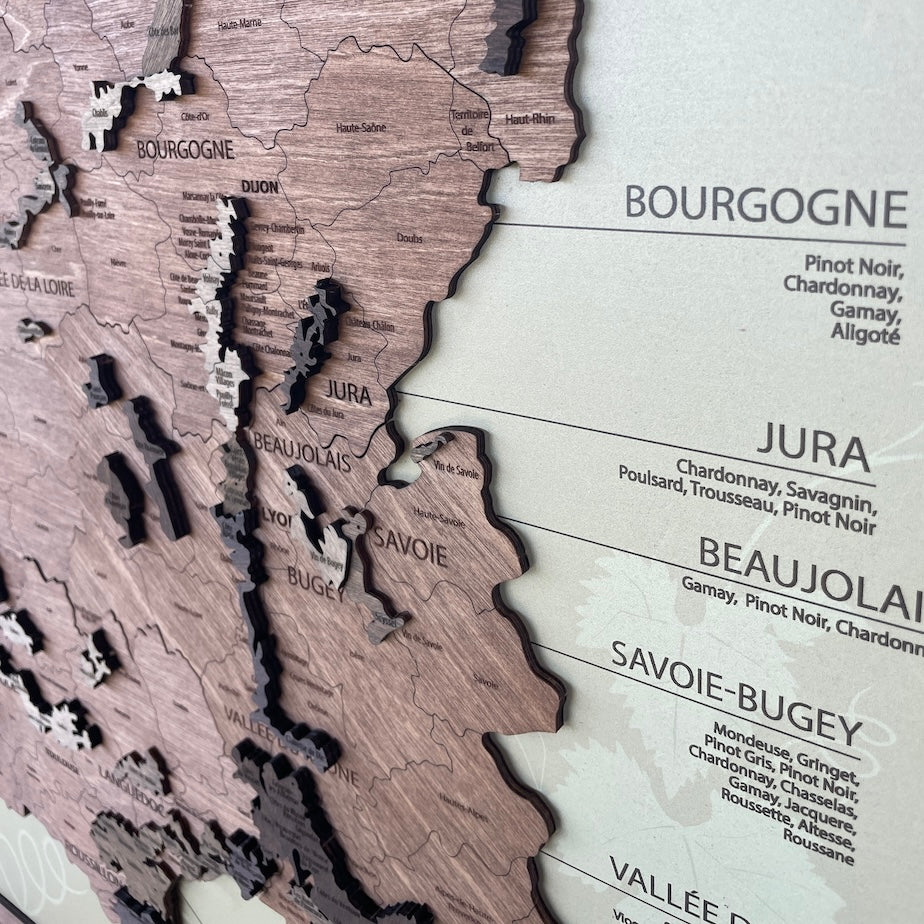
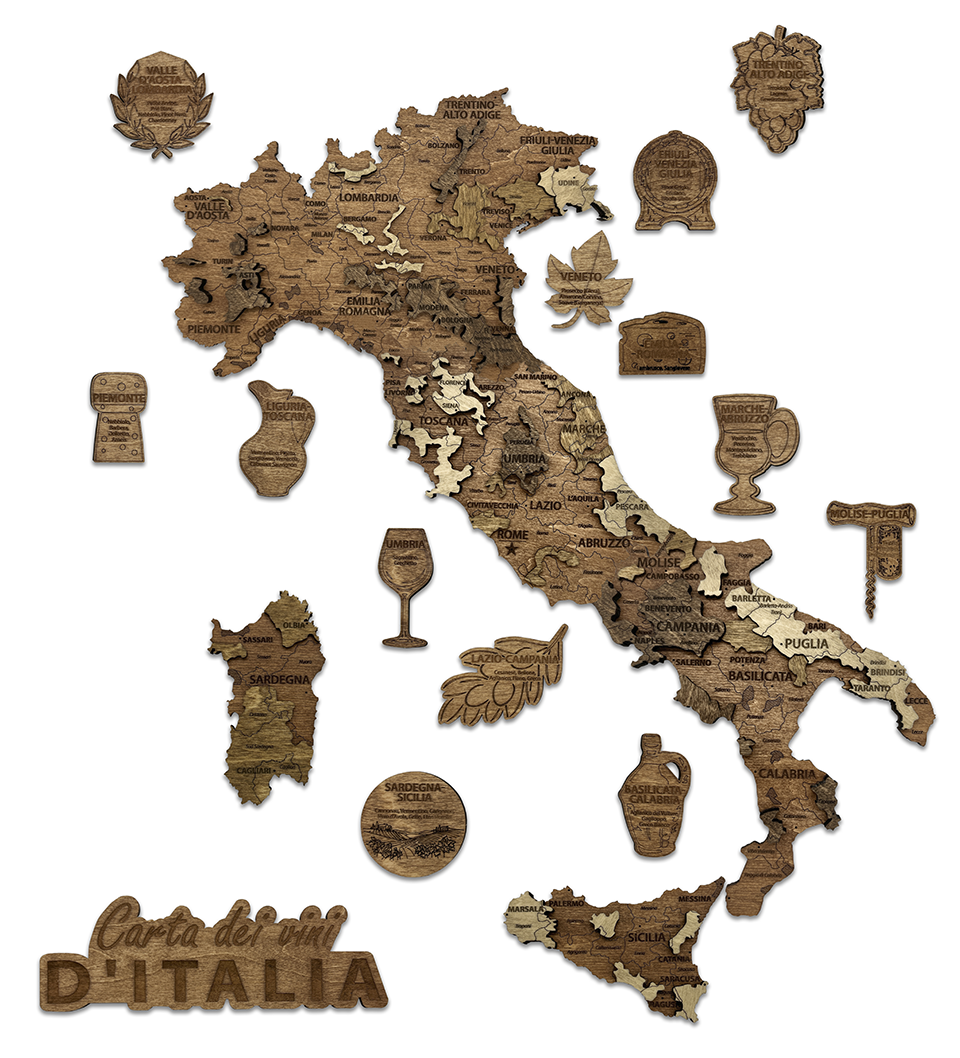
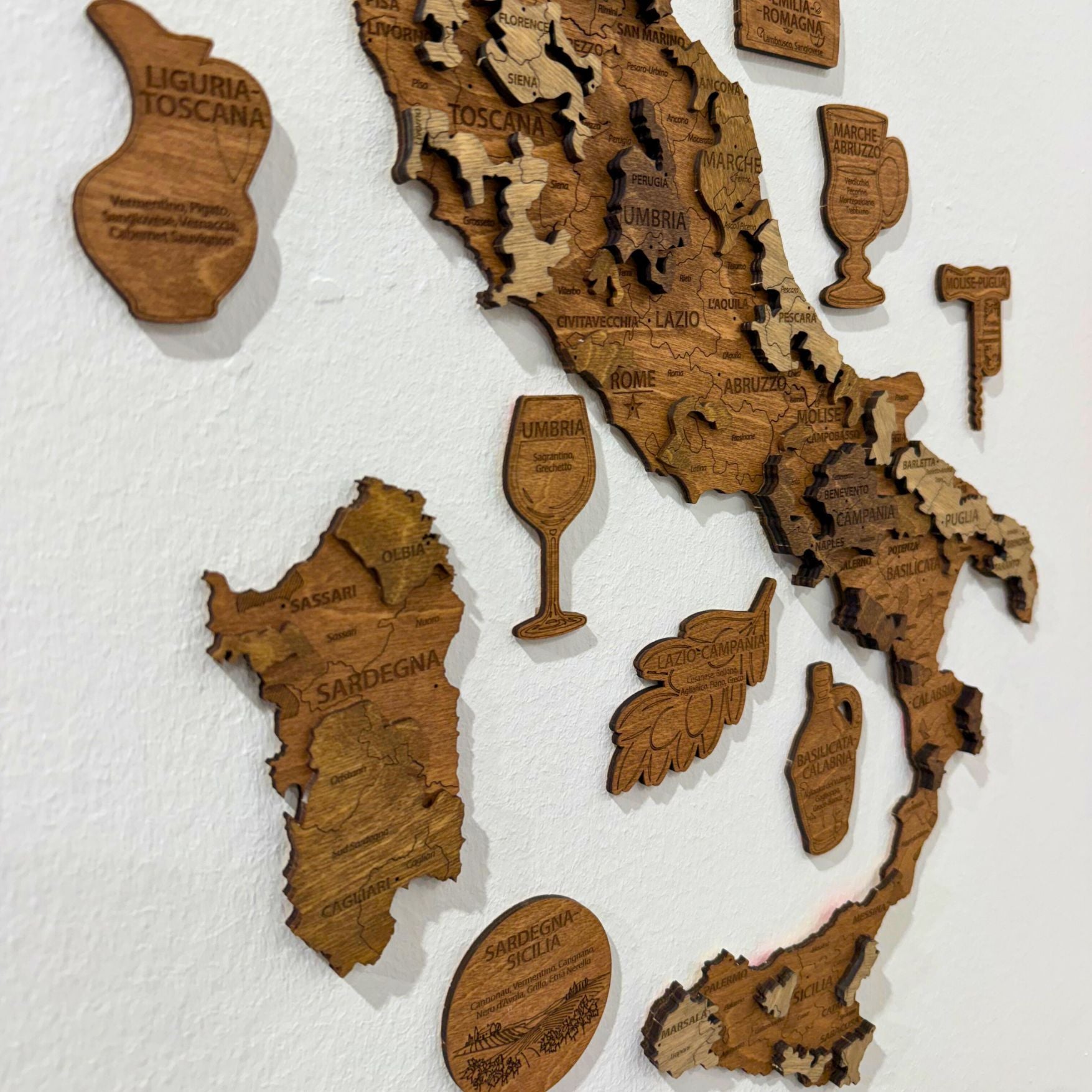
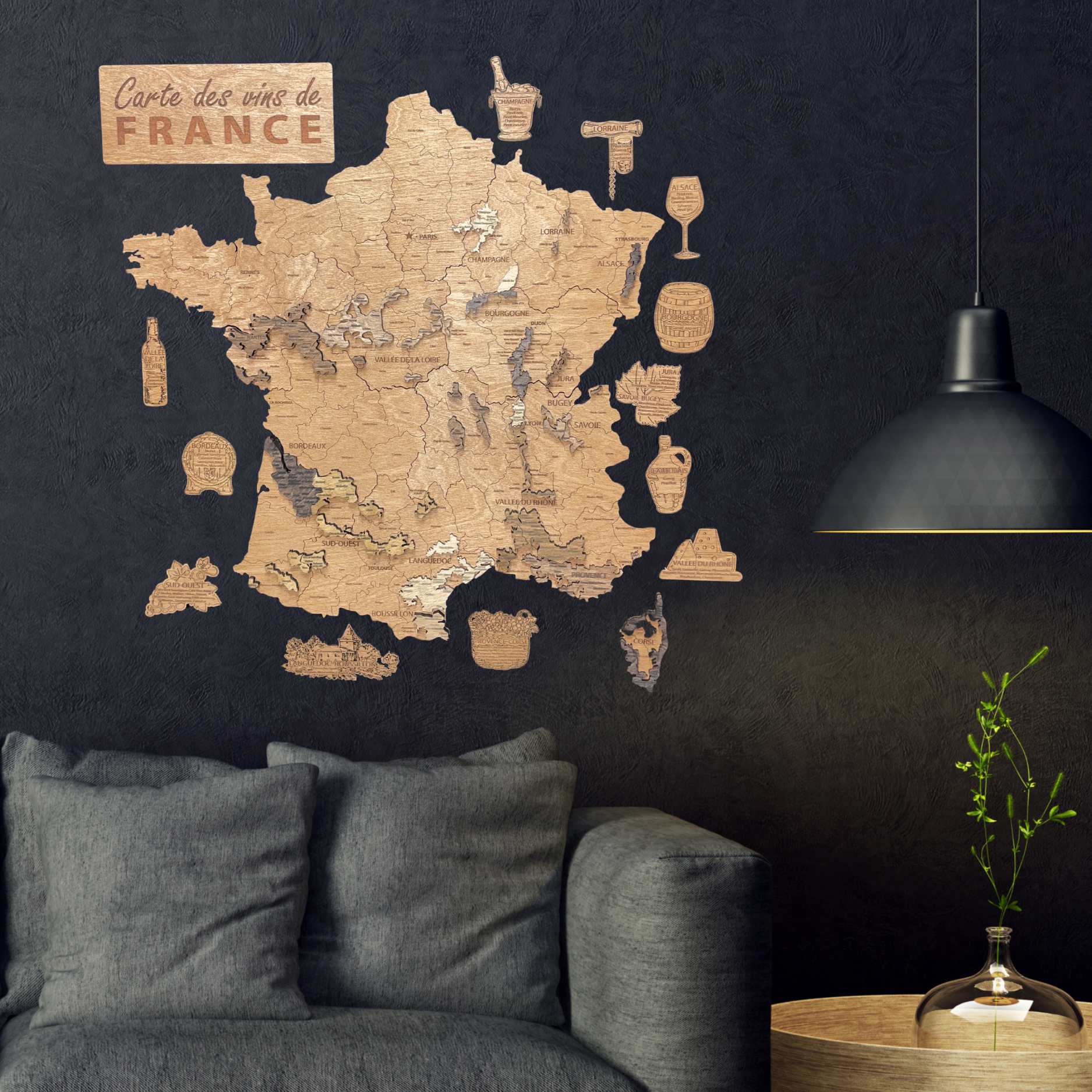
Those grown in each region, engraved on its badge. On the wooden maps each region is a separate wooden badge shaped like something from the trade – an ice bucket for Champagne, a barrel for Burgundy, a corkscrew for Lorraine, a bottle for the Loire, a jug for Liguria and Tuscany, a glass for Umbria – and under the region name each one lists its grapes: Pinot Noir, Chardonnay, Gamay and Aligoté for Bourgogne, Merlot and the Cabernets for Bordeaux, Savagnin and Poulsard for the Jura. On the panels the same lists are printed on the chart beside each region.
On the wooden map of France the base carries more than the badges. The wine villages and vignobles are engraved on the wood itself – Volnay, Pommard and Meursault along the Côte de Beaune, the Médoc, Graves and Entre-Deux-Mers around Bordeaux, Bergerac and Cahors in the Sud-Ouest – between the départements and the towns. It is a map that is read, not only recognised.
The badges go where you put them. Tight to the coastline the map stays compact; spread wide it fills far more wall than the country's own measurement suggests.
Which of these maps are of France?
Three: two framed panels, one on a cool cream chart in dark walnut and one on warm parchment in light oak, and the wooden map mounted piece by piece with a badge for each wine region. All three name the same thirteen wine regions – Champagne, Lorraine, Alsace, Bourgogne, Jura, Savoie-Bugey, Beaujolais, the Vallée du Rhône, Provence-Corse, Languedoc-Roussillon, the Sud-Ouest, Bordeaux and the Vallée de la Loire – with their grape varieties. What differs is how they mount and how much wall they need. The Maps of France collection gathers them with our 2D and 3D maps of the country.
France or Italy?
France is the more familiar to most European buyers and the more likely to be read at a glance. Italy is the more surprising: all twenty regions produce wine, which people know in the abstract and find striking laid out, from Alto Adige at the Austrian border to Sicily.
Who are these for?
People who drink wine attentively rather than people who like maps. The subject is narrow on purpose: a wine map is not decoration that happens to be a map, it is a reference someone will stand in front of.
Why does a wine map suit a kitchen or a dining room?
Because it fills a wall with what the room is already about. A bottle rack or a framed print is decoration applied to a room; a wine map beside the table, in the kitchen or by the cellar door reads as belonging there. It hangs as naturally in a wine shop or a cellar as over a dining table, and our France map has been photographed in both.
It also works at close range in a way most wall art does not. A print is looked at once; a map with the villages of Burgundy and the vignobles of Bordeaux engraved on it is read again and again, which suits a wall people stand next to rather than walk past.
How accurate are the boundaries?
Decorative rather than authoritative. Vineyard boundaries are simplified to what can be cut and read at this scale, and the smallest designations are grouped rather than drawn separately. A sommelier will find omissions.
Is a wine map the right gift?
When the person already has good wine and a wall to give to it, yes. If either is uncertain, the rest of our Around the Wine collection holds gifts that need no wall: boxes that carry a single bottle and come with a two-glass holder, one of which becomes a bird nesting box once it is empty, and a notebook for tasting notes.