







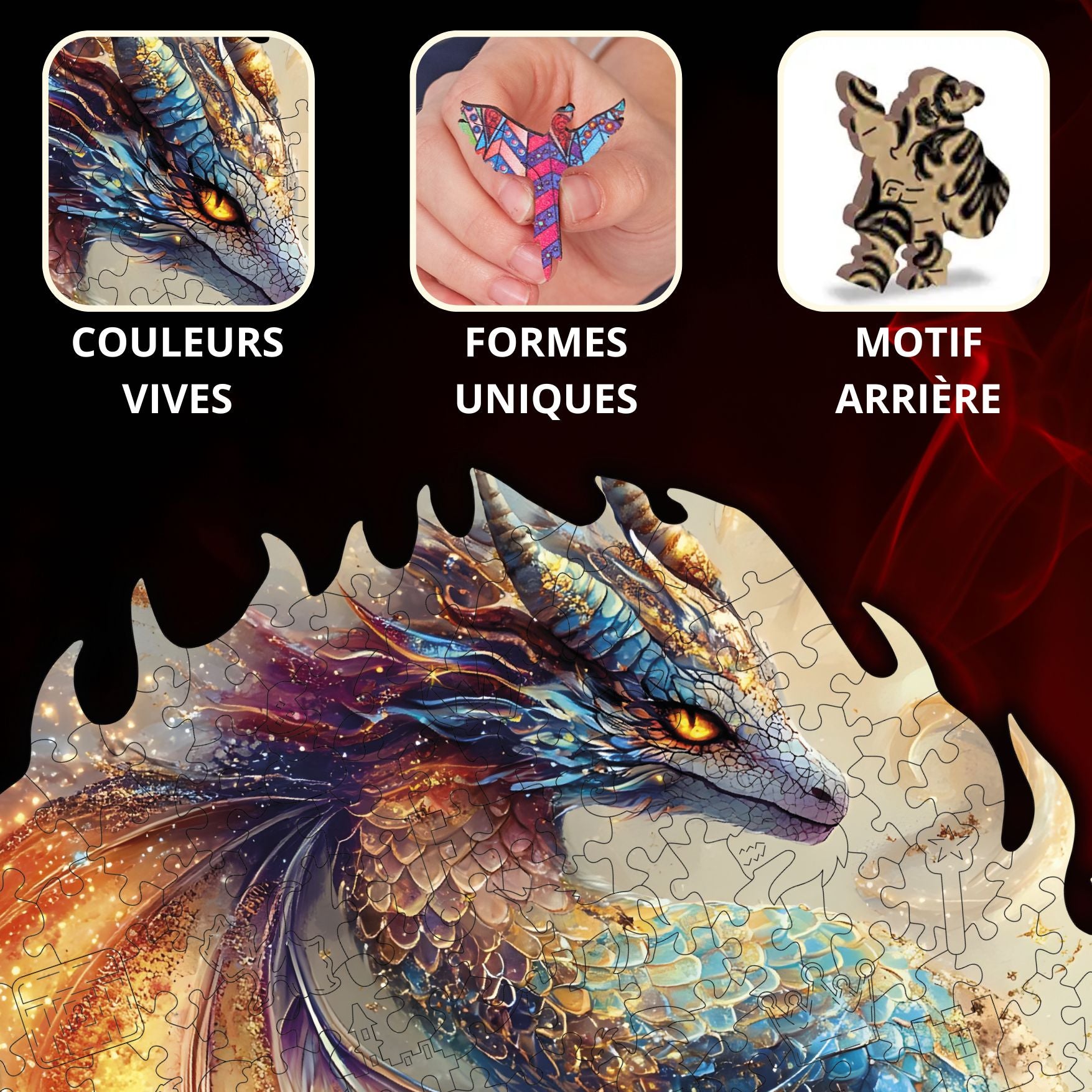


Celestial Dragon Wooden Puzzle
A dragon coiled into a circle, scales at the head and a nebula at the tail – 250 pieces
Specifications
| Material | Wood |
|---|---|
| Dimensions | 28 × 28 cm |
| Thickness | 4 mm |
| Pieces | 250 |
| Difficulty | Hard |
| Recommended age | 14+ |
| Made in | Poland |
Shipping
Every order ships from our fulfilment centre in France – never dropshipping. Orders are dispatched within 24 hours on working days; order before 10:30 and it leaves the same day. You’ll receive your tracking number by email at dispatch.
France: 2–4 working days – free home delivery from €40.
Rest of Europe: 2–10 working days, depending on destination.
Returns
You have 14 days from delivery to change your mind – no reason needed. Write to us first at info@creatifwood.com, then send the product back unused, in its original packaging.
Return shipping is at your charge; we refund the full order amount within 14 days, to your original payment method.
Received a damaged or wrong item? Contact us within 14 days with photos – we’ll make it right.
About this product
A dragon coiled into a circle
The body wraps once around itself and closes, so the composition reads as a disc rather than as a creature standing on a background. The head rests at the top, muzzle pale lavender and finely scaled, two ribbed horns swept back. The single amber eye with its black slit is the sharpest point of colour on the board, and the only place your eye settles.
Two textures, one animal
The upper body is scale work: individual overlapping plates in teal, cobalt and rose, each catching light differently, with gold dust scattered along the ridges. The lower body gives way to a nebula. Deep violet and midnight blue shot through with white stars, one of them flaring in the lower right like a struck match.
Between them runs the wing, amber and translucent, edged in gold. It is the seam where the two halves of the artwork meet.
Why the tail is the hard part
The starfield has no edges. Where the scaled shoulder gives you plate boundaries and colour changes to work from, the nebula shades continuously from violet into blue with nothing but scattered points of light to orient by. Pieces from the tail can be turned four ways and look plausible in three of them.
Work the head and horns first, then the wing, and leave the lower third until the surrounding pieces box it in.
Two people naturally split this one down the seam: one takes the scales, where edges and colour changes reward quick eyes, the other takes the starfield, which suits whoever is happy to sit with something slow. The wing is where you meet.
The disc and the flames
The outer edge is not a plain circle. It breaks into flame tongues, pale cream against the wall, so the finished piece keeps a silhouette even though the artwork sits inside a round frame.
The two dragons
Few animals split as sharply between traditions. In Chinese and Japanese belief the dragon brings rain and fortune and stands for imperial authority; in Western Christian iconography it is the thing the saint has to kill. This one borrows from both sides of the divide: the horns and bat-lined wings of the western dragon, the coiled, watchful calm of the eastern one. It guards rather than threatens.

Our craftsmanship
Made by our family, piece by piece
Every creatifwood puzzle starts as a sheet of birch plywood in our family workshop. We laser-cut every piece into its own shape – no two are alike – check each set by hand, and pack it in a gift-ready box. No production lines, no shortcuts – just a small family that loves working with wood, and takes it personally that your puzzle brings people together around the table.
Meet the family behind your puzzleFrequently asked questions
Is a round puzzle easier than an animal-shaped one?
The outer edge is a clean circle – on some designs with a decorative fringe around it, like the Dragon's flames – so unlike our silhouette designs you do have a border to build first. The difficulty moves elsewhere: the artwork is painted rather than patterned, with soft gradients and deep backgrounds instead of flat ornament, so there are fewer hard lines to sort by.
What are the animal-shaped pieces for?
They are called whimsy pieces, a tradition that goes back to Victorian puzzle cutters who added recognisable shapes on a whim while working. Parker Brothers made it a standard in 1908. They do not interlock the way ordinary pieces do, so the pieces around them hold them in place.
Is this harder than a cardboard puzzle of the same size?
Usually yes. The piece shapes are irregular rather than a uniform grid, several pieces are cut as figures, and the painted backgrounds shade gradually rather than breaking into distinct colour blocks.
How long will it take?
Honestly: longer than you expect. The border helps you start, but the painted artwork shades gradually instead of breaking into blocks, and the irregular pieces keep you guessing. We think that is part of the pleasure – it is made to be savoured, not raced.
Can I glue it and hang it on the wall?
Yes. Use a glue made for puzzles rather than a general craft adhesive: it runs into the joints and dries as a thin clear film that protects the face. We stock the Cléo'Puzzle glue-varnish, rated for cardboard, wood and MDF, with a precision nozzle for boards that have no straight edges. Work in thin coats and let each one dry. Gluing is permanent – if you would rather rebuild the puzzle one day, or keep the front matt, dry adhesive film on the back is the alternative. Once sealed, the board can be framed or hung as it is.
Why does it smell of wood when I open the box?
Laser cutting leaves a light trace of scorching on the edges. We clean the pieces before packing, but a faint smell of cut wood in the first days is normal and fades.
Which age is it suitable for?
It is shown on each product page under Specifications. The designs in this range are marked 14+.
What if a piece is missing or broken?
Write to us with a photo and we will send a replacement. Details are on our Missing Pieces page.